
For a warehouse or loading dock, rolling steel service doors and high-speed doors cover most needs. Pick sheet doors for lighter, lower-cost openings, insulated doors where temperature matters, fire-rated doors for code-required openings, counter doors and grilles for service windows and storefronts, and aluminum or glass doors where visibility counts more than forced-entry resistance.
Commercial roll-up door types at a glance
- Rolling steel service doors and high-speed doors cover most warehouse and loading dock needs.
- Sheet doors fit lighter, lower-cost openings; insulated doors help where temperature matters.
- Fire-rated doors serve code-required openings and need annual inspection and drop testing.
- Counter doors, grilles, and aluminum or glass doors suit smaller or visibility-focused openings.
Commercial roll-up doors come in eight main types: rolling steel service doors, roll-up sheet doors, insulated rolling doors, fire-rated rolling doors, high-speed rolling doors, rolling counter doors, rolling security grilles, and aluminum or glass rolling doors. They share one mechanism, a curtain that winds around a barrel above the opening, and differ in curtain material, speed, insulation, and the job the door has to do.
For a warehouse or loading dock, rolling steel service doors and high-speed doors cover most needs. Pick sheet doors for lighter, lower-cost openings, insulated doors where temperature matters, fire-rated doors for code-required openings, counter doors and grilles for service windows and storefronts, and aluminum or glass doors where visibility counts more than forced-entry resistance.
How a roll-up door works
A roll-up door has a flexible curtain made of slats, a single sheet, or fabric. The curtain rides in guides on both sides of the opening and winds around a barrel mounted above it, usually behind a hood. A spring counterbalance in the barrel offsets the curtain’s weight, and an operator, chain hoist, or hand crank turns the barrel. Because the curtain coils overhead instead of sliding along the ceiling, rolling doors suit openings with limited ceiling space, though they still need clearance above the opening for the coil and hood.
Comparison at a glance
| Type | Curtain | Best for | Main trade-off |
|---|---|---|---|
| Rolling steel service door | Interlocking steel slats | Docks, warehouses, equipment storage | Lower insulation than sectional doors |
| Roll-up sheet door | One corrugated steel sheet | Self-storage, outbuildings, light duty | Not built for heavy daily cycling |
| Insulated rolling door | Insulated slats | Temperature and noise control | Lower R-value than insulated sectional doors |
| Fire-rated rolling door | Fire-tested steel slats | Code-required wall openings | Annual testing and added inspections |
| High-speed rolling door | Fabric, vinyl, or steel | High-traffic and climate-controlled openings | Higher cost than standard doors |
| Rolling counter door | Light slats | Service windows, concession openings | Small openings only |
| Rolling security grille | Open links or perforated slats | Storefronts, garages, mall entries | Does not seal against air or weather |
| Aluminum or glass rolling door | Aluminum slats or glazed panels | Retail and restaurant fronts | Less forced-entry resistance than steel |
Rolling steel service doors
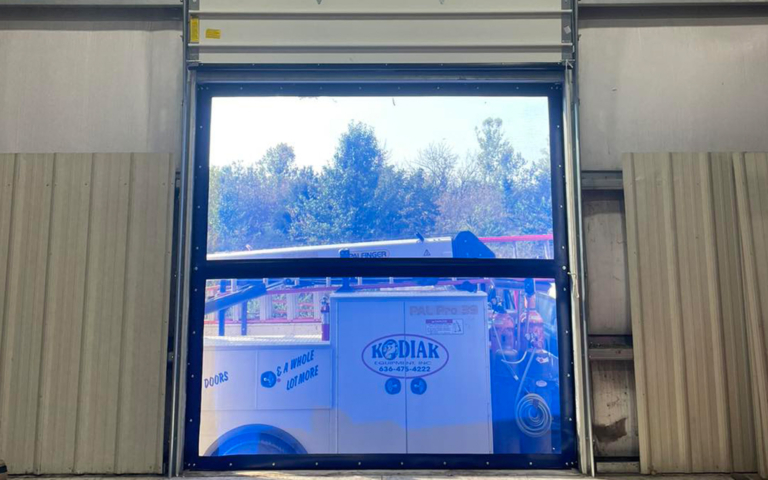
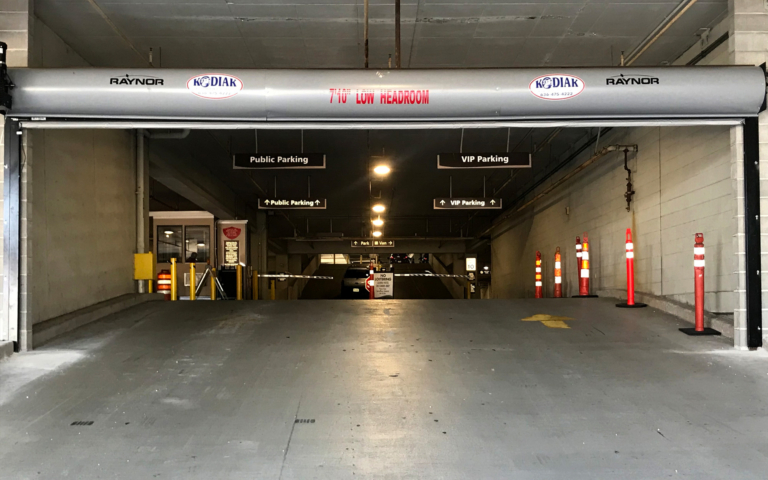
The rolling steel service door is the standard commercial roll-up door. Interlocking steel slats form a curtain that handles heavy use, and a slat-style curtain resists impact and forced entry better than most lighter designs. These doors show up on loading docks, in warehouses and manufacturing plants, and on equipment storage bays, and they are available in large openings.
Kodiak installs and services rolling steel doors from Raynor, Wayne Dalton, and Hormann, including Wayne Dalton’s Rolling Service Door 800 and 900 lines. Doors can be built to the opening’s dimensions and ordered with insulation options and finishes. See Kodiak’s rolling steel doors page for the product lines.
Roll-up sheet doors
A roll-up sheet door uses one corrugated sheet of steel as the curtain instead of many interlocking slats. That cuts the number of moving parts and the cost, which is why sheet doors are common in self-storage facilities, retail storage rooms, and outbuildings. The trade-off is durability under frequent use. A sheet door is built for lighter duty, so a busy dock that cycles all day is better served by a slat-style door.
Insulated rolling doors
Insulated rolling doors add insulation to the curtain to cut heat transfer and noise, which helps in conditioned warehouses, food handling areas, and buildings in extreme climates. Wayne Dalton’s Thermotite line, listed on Kodiak’s rolling steel page, is one example. The curtain winds into a barrel, so rolling doors generally reach lower R-values than insulated sectional doors, which can use thick panels. If insulation is the main requirement, compare both door styles before you buy. Our guide to rolling doors vs. traditional doors covers that comparison.
Fire-rated rolling doors
A fire-rated rolling door closes over a wall opening to slow the spread of fire between zones. It uses fire-tested steel slats and a release that drops the door automatically when the fire alarm activates or a fusible link melts. Kodiak’s rolling steel page lists the Wayne Dalton FireStar line and Raynor fire doors, and its high-speed page notes fire-rated options tested to UL 10B and UL 10C with 1-hour, 1.5-hour, and 3-hour ratings.
Fire-rated doors carry extra requirements. The rating and listing have to match the opening, local code decides which rating you need, and installation can involve inspections beyond a normal building permit. The door also needs inspection and a drop test at least annually, which Kodiak handles through its fire door drop testing service in coordination with local fire authorities. Confirm ratings with the manufacturer and your fire marshal before you order.
High-speed rolling doors
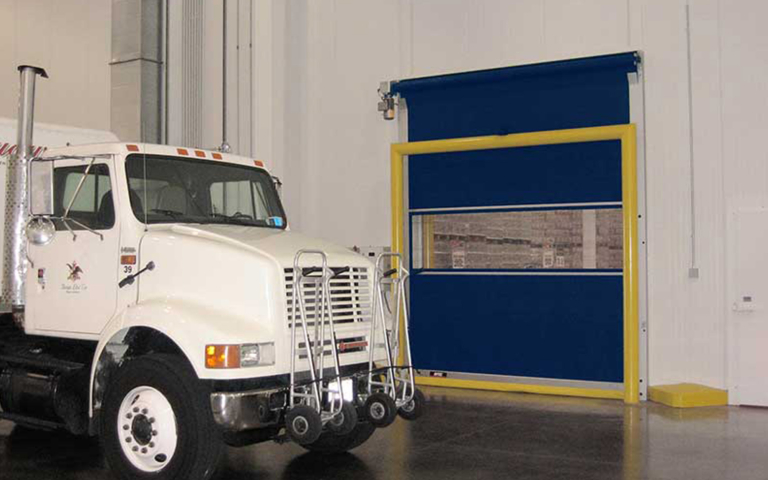
High-speed rolling doors move much faster than standard doors, which limits air loss, keeps forklift traffic flowing, and separates zones in a facility. According to Kodiak’s high-speed door page, fabric curtains run 40 to 80 inches per second, vinyl doors run 40 to 60, rolling steel high-speed doors run 24 to 36, and freezer doors run 60 to 100 inches per second. A standard overhead door moves about 7 to 10 inches per second.
Fabric is the most common high-speed curtain, and a fabric curtain that gets clipped can pop out of its side guides and reset without structural damage. Rolling steel high-speed doors suit exterior openings, high-wind areas, and higher-security uses. Insulated panel and freezer versions add better R-value, heated side columns, and heated bottom bars to prevent icing. Kodiak works with Hormann, Rytec, Goff, ASI, Albany, Dynaco, Cornell, and Cookson and recommends doors by cycle count, opening size, environment, and budget, since a distribution door cycling 300 to 500 times a day has different needs than a storeroom door.
For a deeper look, see Kodiak’s high-performance rolling doors, our buying guide for high-performance rolling doors, and our post on how high-performance doors cut energy use. Cold rooms have their own requirements, covered in our cold storage door features guide.
Rolling counter doors
A rolling counter door is a smaller roll-up door built for service openings such as a cafeteria serving window, a concession stand, a pharmacy counter, or a lobby kiosk. It rolls into a compact hood above the opening and typically has a lock to secure the counter when it is closed. Counter doors suit small openings only. They are not built for dock-scale loads or traffic.
Rolling security grilles
A rolling security grille uses open links or perforated slats instead of a solid curtain. People can see through it and air can pass, so grilles fit storefronts, mall entries, parking garages, and any opening where visibility and ventilation matter along with security. Because a grille does not seal, it does not stop drafts, dust, or weather the way a solid door does. Kodiak’s rolling steel page lists the Wayne Dalton Rolling Grille.
Aluminum and glass rolling doors
Aluminum rolling doors use aluminum slats, which are lighter than steel and resist corrosion. Glass or glazed versions add vision panels so customers can see in when the door is open or closed, which suits restaurants, retail fronts, and showrooms. They look better than steel and open easily, but they give up resistance to forced entry and impact. Choose them for appearance and visibility, and add a grille or a steel door where security is the priority.
Operator and control options
Any of these doors can run on a manual chain hoist or hand crank, or on a motor operator. A chain hoist is the lowest-cost option and works for lighter, low-traffic doors. A motor operator suits larger doors, frequent use, and any opening where staff should not have to pull a chain. Kodiak sources and repairs commercial operators, including the Raynor PowerHoist line, and sizes them to the door’s weight, cycle count, and security needs. See Kodiak’s door operators page.
Roll-up doors vs. sectional doors
Rolling and sectional doors solve the same opening in different ways. A sectional door rides on ceiling tracks, which uses overhead space, and its thick panels can carry more insulation. A rolling door coils above the opening, uses less ceiling space, and offers a higher degree of physical security. Sectional doors are the usual choice when insulation is the priority and ceiling space is available. Rolling doors fit tight overhead clearances and higher-security openings. Kodiak installs both, including sectional doors.
How to choose a commercial roll-up door
Start with how the opening is used. A dock door cycling hundreds of times a day needs a slat-style or high-speed door with a motor operator. A storeroom door opened a few times a week can use a sheet door and a chain hoist. Then work through the rest of the decision:
- Check the environment: temperature control points to insulated or high-speed doors, and wind exposure points to a higher wind load rating.
- Confirm code requirements: a fire-rated wall opening needs a listed fire door with the right rating.
- Decide on security: steel slats resist forced entry better than aluminum, glass, or sheet curtains.
- Plan for service: choose a door your service provider can repair, with parts that are available locally.
Cost depends on size, curtain type, insulation, fire rating, operator, and installation conditions, so a written estimate for your actual opening is more useful than a general price range. Kodiak offers free estimates for new installations and replacements.
Commercial roll-up doors in St. Louis
Kodiak Equipment Services has installed, repaired, and maintained commercial doors in the St. Louis metro and neighboring Illinois since 1990. If a door you already own has problems, our guide to common roll-up door problems and fixes explains what to check first.
Call 636-475-4222 or contact the team to talk through your opening.
Request a Commercial Roll-Up Door Quote
Tell Kodiak about the opening and how the door will be used. The team can help compare suitable options.
"*" indicates required fields
“Cost depends on size, curtain type, insulation, fire rating, operator, and installation conditions, so a written estimate for your actual opening is more useful than a general price range.”
Kodiak installs and services rolling steel doors and high-performance rolling doors.