
Published ratings for insulated rolling steel doors cluster around R-6 to R-8. Insulated sectional doors are rated higher, and insulated high-speed panel doors beat fabric ones. Choose an insulated roll-up door when you need a rolling door for security, clearance, or durability and also want better temperature control than a plain steel curtain gives. If insulation is the top priority and you have ceiling space, price a sectional door too.
Insulated roll-up doors at a glance
- Published insulated rolling steel door ratings cluster around R-6 to R-8.
- Check guide, header, and bottom seals; air leakage can outweigh the benefit of insulated slats.
- Compare a sectional door if insulation is the priority and ceiling space is available.
- A retrofit kit can change spring balance, coil clearance, and a fire door's listing.
An insulated roll-up door is a rolling steel door whose slats are filled with foam or built as double-wall panels, so the curtain slows heat moving through the opening. It cuts heat loss in a heated warehouse, keeps a conditioned space steadier, and reduces noise from outside. It does not match the R-value of an insulated sectional door, and it only performs as rated if the seals around the curtain are in good shape.
Published ratings for insulated rolling steel doors cluster around R-6 to R-8. Insulated sectional doors are rated higher, and insulated high-speed panel doors beat fabric ones. Choose an insulated roll-up door when you need a rolling door for security, clearance, or durability and also want better temperature control than a plain steel curtain gives. If insulation is the top priority and you have ceiling space, price a sectional door too.
“Roll-up door” covers several products, and a plain slat curtain is mostly a sheet of steel with very little resistance to heat flow. Insulation is what changes that, and the way it is added determines how well the door performs and what it costs in headroom, weight, and upkeep. This guide covers how insulated rolling doors are built, what R-values to expect, whether a retrofit kit is a good idea, and how to compare them with other door types.
How an insulated roll-up door is built
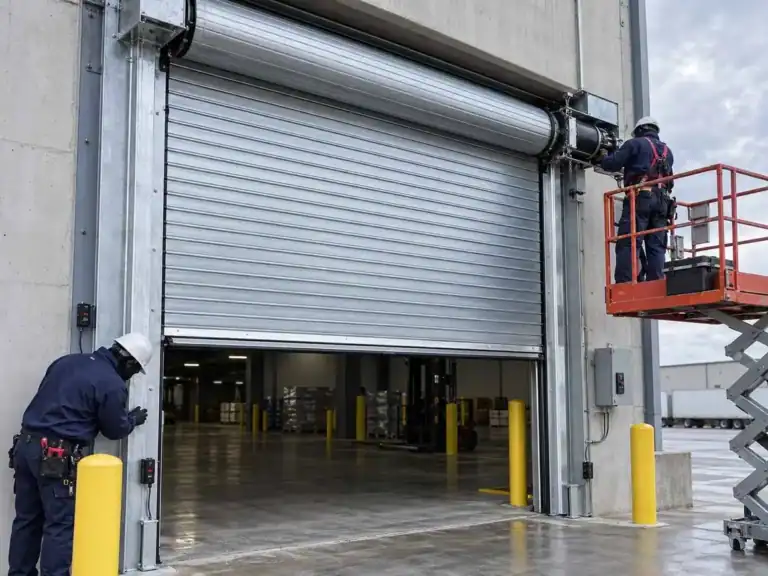
A standard rolling steel door uses interlocking steel slats that wind around a barrel above the opening. An insulated version changes the slats. The common construction is a foam-filled slat, where insulation sits between two steel skins, or a double-wall slat that holds an insulating layer inside. The slats still interlock and coil the same way, so the door keeps the compact footprint and the forced-entry resistance of a rolling steel door.
Three practical effects follow from the thicker slat:
- The curtain weighs more, so the counterbalance spring and the operator are sized for a heavier door.
- The coiled curtain is larger, so the door needs more headroom above the opening than a plain steel door of the same size. Sources in this category cite figures from roughly 12 to 18 inches for standard doors, and as much as 29 inches for some insulated models, depending on size and slat depth. The exact number comes from the manufacturer’s drawing for your door.
- The slats cost more, so an insulated door costs more than a plain steel door of the same size.
Kodiak’s rolling steel page lists Wayne Dalton’s Thermotite line among its products and says doors can be customized in dimensions, insulation options, and finishes. See Kodiak’s rolling steel doors page for the lines Kodiak installs.
What R-value to expect
R-value measures resistance to heat flow, and a higher number means less heat passes through the door. Manufacturer ratings for insulated rolling steel doors fall in a narrow band:
| Product example | Published R-value | Notes |
|---|---|---|
| Cornell and Cookson Thermiser insulated rolling door | R-8.0 | Calculated using the ASHRAE Handbook of Fundamentals |
| Alpine IMB-V7 insulated rolling door | R-8.01 | Higher-grade slat |
| Alpine IMB-V5 insulated rolling door | R-6.82 | Lower-grade slat |
Treat these as examples of the range, not a promise for every model. Each maker rates its own door, and a figure from one catalog is not a head-to-head test against another. When you compare doors, ask for the published R-value and the standard it was calculated under, and compare like for like.
One caution matters more than the number itself. A rating describes the door surface. It does not count air leaking around the curtain, and on a rolling door that leakage is often the larger loss. The curtain sits in side guides and under a hood, and any gap at the guides, the header, or the bottom bar lets air through regardless of how well the slats are insulated. Our guide to roll-up door seals covers how to close those gaps.
Insulated roll-up door vs sectional vs high-speed
| Door type | Typical insulation | Strength | Trade-off |
|---|---|---|---|
| Insulated rolling steel | Around R-6 to R-8 on published models | Security, durability, tight overhead clearance | Lower R-value than foam-core sectional doors |
| Insulated sectional | Higher; some polyurethane-core models are rated in the high teens or above | Best insulation per square foot of door | Needs ceiling track space, less forced-entry resistance |
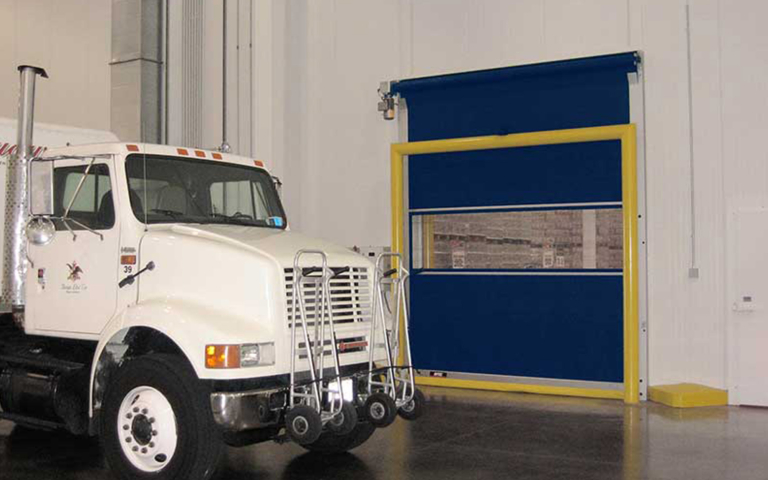
| High-speed, insulated panel | Higher than fabric, per Kodiak’s high-speed page | Fast cycling cuts air exchange | Higher cost, electrical and control needs |
| High-speed, fabric | Low | Speed, flexible curtain | Little resistance to heat flow |
Published ratings for sectional doors vary widely between sources, so confirm the number for the specific model you are considering.
Speed matters here too. A door that stays open through a whole truck load loses more conditioned air than any slat insulation can recover. Kodiak’s high-performance rolling doors page covers insulated panel and freezer versions of fast doors, and our post on how high-performance doors cut energy use explains the air-exchange side of the problem. For a broader comparison of door styles, see rolling doors vs. traditional doors and our overview of sectional doors.
When an insulated roll-up door makes sense
An insulated rolling door fits when the opening has several needs at once:
- The space is heated or cooled and a plain steel curtain wastes energy.
- Ceiling space is tight, which rules out sectional track.
- The opening needs the forced-entry resistance of steel slats. See our guide to roll-up security doors.
- Noise from outside, such as a loading yard or a street, reaches work areas.
- The door cycles often enough that rolling steel’s durability matters.
It fits less well when the opening is a freezer or a cold room. Those spaces need doors designed for large temperature differences, with heated bottom bars and side columns to prevent icing, and Kodiak’s cold storage doors page and our cold storage door features guide cover those. It also fits poorly when insulation is the only priority and you have the ceiling space, because a foam-core sectional door will usually rate higher for the money.
Retrofit insulation kits for an existing roll-up door
Searches for “commercial roll up door insulation kit” are small, but the question is common: can you insulate a door you already own? Kits exist, usually as insulation panels or a curtain liner added to the existing curtain. Before you buy one, ask a door technician four things.
- Does the added weight change the spring balance? A heavier curtain can leave the spring under-tensioned, which strains the operator and the spring.
- Does the thicker coil still fit in the hood and the headroom? A curtain that cannot coil fully will jam.
- Is the door fire-rated? A fire door’s listing covers the door as built, and adding material can void it. Do not modify a fire-rated door without approval from the manufacturer and the local authority.
- Would new slats or a new door cost little more? On an old door with worn seals and bent slats, putting money into a kit may not make sense.
Where a kit is allowed and the door is sound, fixing seals first usually gives more return than adding insulation, since air leaks cost more than conduction through the slats.
Other points to check before you order
Wind load matters on exterior openings. Insulated slats are heavier, but wind rating is set by the door’s construction and the opening size, so ask for the rating for your site if the door faces outside. Condensation matters in humid or cold climates, where an insulated door can help keep interior surfaces above the dew point. Noise reduction is real but modest compared with a solid wall, so do not expect an insulated rolling door to quiet a loud process on its own. Finish and corrosion resistance matter on any steel door, and galvanized slats with a painted finish are common choices.
Plan for service as well. A heavier curtain puts more load on springs, bearings, and the operator, so a maintenance schedule matters more, not less. See our maintenance tips for rolling doors and our guide to common roll-up door problems.
What affects the cost of an insulated roll-up door
The price depends on several variables, so a written estimate for your opening is more useful than a general range:
- Width and height of the opening
- Slat type and gauge, and the insulation grade
- Operator type, from chain hoist to motor, and its controls
- Wind load and fire-rating requirements
- Finish, and any added seals or windows
- Installation conditions, such as headroom, mounting, and access
Kodiak offers free estimates for new installations.
How to choose an insulated roll-up door
Start with the opening and the space behind it. Measure the width, height, headroom, and side room, because insulated doors need more room than plain ones. Then decide what the door has to do: save heat, resist forced entry, cycle often, or all three. Ask for the published R-value and the standard behind it, plus the headroom and wind load for the size you need. Pick a door your service provider can repair, with parts available locally. If the numbers do not work, compare a sectional or an insulated high-speed door before you commit.
For sizing details, see our guide to commercial roll-up door sizes. For a map of the full range, see our overview of the types of commercial roll-up doors.
Insulated roll-up doors in St. Louis
Kodiak Equipment Services has installed and serviced commercial doors in the St. Louis metro and neighboring Illinois since 1990. Call 636-475-4222 or contact the team to talk through your opening.
Request an Insulated Roll-Up Door Quote
Tell Kodiak about the opening and how the door will be used. The team can help compare rolling, sectional, and high-speed options.
"*" indicates required fields